News
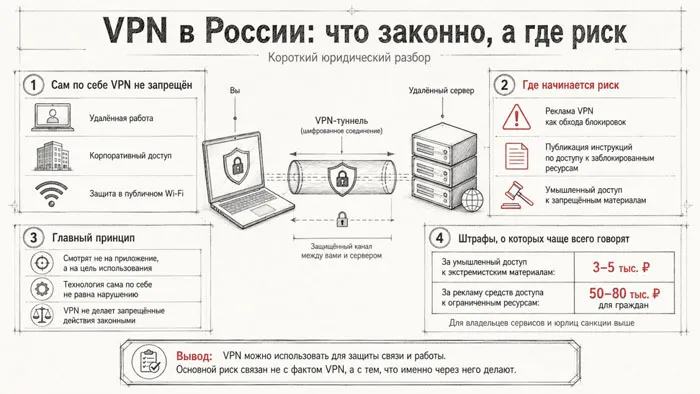
In itself, VPN is not prohibited in Russia. The law does not punish a citizen for an installed application, a connection to a corporate network, remote work through a secure tunnel, or protection of traffic on public Wi-Fi. The risk arises not from the «connect» button, but from the purpose of use, advertising, public instructions on circumventing blocks, and access to materials for which the law already establishes separate liability.
The legal construct is arranged not as a direct ban on the technology, but as pressure on service owners, search engines, sites hosting instructions, and advertisers. Roskomnadzor may restrict access to VPN services that provide access to prohibited resources and do not comply with the requirements of Russian legislation. The main practical takeaway for a user is simple: a VPN remains a legal tool for protecting a connection and for corporate access, but it ceases to be a neutral shield if it is used to access prohibited content or promoted as a way to circumvent blocks.
This material is intended for legal and responsible use. When working with VPNs, proxies, network tools, and traffic protection means, you must comply with the laws of your country, especially Russia. The instructions must not be used for unauthorized access, surveillance, hacking, violation of service rules, or illegal circumvention of blocks.
The basic norm lies in Article 15.8 of the law «On Information». The law speaks not about a home user with an app on a phone, but about the owners of networks, resources, and software-and-hardware means through which access can be obtained to resources restricted in Russia. Such owners are prohibited from providing, within the territory of Russia, the possibility of access to blocked resources.
The mechanics look like this. Roskomnadzor maintains a state system containing a list of restricted resources. The owner of a service that falls under the requirements must connect to the system and restrict access to prohibited addresses. If the service does not comply, the regulator may block access to it. In February 2026, the RKN reported that it had restricted access to 469 VPN services in Russia, referring to the rules of centralized management of the public communication network.
This is where the confusion arises. People hear «VPNs are being blocked» and translate that into «you get fined for using a VPN». But blocking a service and fining a user for the mere fact of connecting are two different legal actions. The law may shut down a specific service, but it does not turn every use of a VPN into an offense.
Since 2025, the Code of Administrative Offenses (CoAO) has contained norms that strengthened liability around VPNs. The most noticeable one for ordinary users is Article 13.53 of the CoAO. It concerns the intentional search for, and obtaining of access to, knowingly extremist materials, including through the use of means of access to restricted resources. The sanction for citizens is a fine of 3,000 to 5,000 rubles. Importantly, the composition of the offense is built around the intentional search for and access to specific materials, not around the VPN client itself on the device.
For owners of VPN services and similar tools, separate liability was introduced for violating the procedure of interaction with the regulator, for refusing to connect to the state system, and for failing to fulfill the obligation to restrict access to prohibited resources. For citizens — if a person acts precisely as the owner of such a means — the fine can range from 50,000 to 80,000 rubles; for officials, from 80,000 to 150,000 rubles; and for legal entities, from 200,000 to 500,000 rubles. Repeated violations bring higher amounts.
A separate risk is advertising. Article 14.3 of the CoAO now provides for a fine for the distribution of advertising of software-and-hardware means of access to restricted resources. For citizens this is 50,000–80,000 rubles, for officials 80,000–150,000 rubles, and for legal entities 200,000–500,000 rubles.
| Situation | Risk Assessment | Why |
|---|---|---|
| Remote work through a corporate VPN | Low | The purpose is related to secure access to the work network, not to access to prohibited resources. |
| VPN for protecting traffic in a hotel, café, or airport | Low | The law does not prohibit encrypting the connection and protecting data from someone else's Wi-Fi network. |
| Publishing an instruction «how to open a blocked site via VPN» | High | The RKN classifies descriptions of ways to access restricted resources, and inducement to use them, among the criteria of prohibited information. |
| Advertising integration of a VPN as a means of circumventing blocks | High | The CoAO provides for a separate fine for advertising such means. |
| Intentional search for extremist materials through a VPN | High | Article 13.53 of the CoAO directly mentions obtaining access, including through the use of means of access to restricted resources. |
The phrase «VPN is banned» is incorrect. The phrase «VPN is completely legally safe» is also incorrect. Russian regulation works through context. The same tunnel can lead to a work admin panel, a banking cabinet, corporate mail, or to a resource whose access is restricted. The legal assessment changes together with the user's actions.
The marketing myth that «VPN makes you anonymous» must also be discarded. A VPN hides your original IP from the final site and encrypts the traffic segment up to the VPN server, but it does not cancel the VPN provider's logs, the payment trail, the browser fingerprint, accounts, application telemetry, or DNS queries under a poor configuration. On the technical side, a VPN protects the channel but does not make the user invisible. On the legal side, a VPN does not turn a prohibited action into a permitted one.
Another mistake is considering any paid VPN «legal». In Russia, there is no clear public list of VPN services that a citizen can use without reservations. If a service is connected to the Russian restriction system and filters prohibited resources, it has fewer regulatory risks in Russia. But for the user, what matters is not the advertising label «legal» but the specific purpose: work access, traffic protection, secure server administration, connection to a corporate network.
For a business, the normal scenario is its own corporate VPN taking into account information security requirements, access logging, multi-factor authentication, and restriction of rights. Such a VPN is needed not to circumvent restrictions but for employees to access internal systems. Ideally, the company describes the purpose of the VPN in local documents, appoints responsible persons, keeps connection logs, and disables the accounts of dismissed employees on the day of dismissal.
For a private user, the safe logic is similar. Do not advertise a VPN as a way to circumvent blocks, do not publish instructions for accessing prohibited resources, do not search for knowingly prohibited materials, do not install free unknown clients from random chats, and do not enter credentials from your mail, bank, or Gosuslugi (State Services) account into them. A free VPN often earns money from traffic, advertising, data collection, or the sale of access to a proxy network. There, legal risk mixes with technical risk.
When choosing a service, you should look not at promises of «complete anonymity» but at a clear jurisdiction, a payment model, the reputation of the owner, the availability of proper clients, support for WireGuard or IKEv2, DNS and IPv6 leak protection settings, and the ability to disable auto-connection on untrusted networks. But even a good service does not remove legal risks if the user themselves goes where Russian law directly forbids going.
Using a VPN in Russia in 2026 is permissible if the VPN serves an ordinary technical purpose: protecting the channel, remote work, access to corporate systems, administration of infrastructure. What becomes punishable is not the presence of a VPN on the phone but specific actions around it: advertising access to restricted resources, publishing instructions on circumventing blocks, operating a service without fulfilling the regulator's requirements, and intentional access to prohibited materials.
The most sober position is this: a VPN is not outside the law, but a strict framework has been built around it. A private user is better off not turning a protection tool into a tool of demonstrative circumvention. A business needs to formalize its VPN as an element of information security infrastructure, not as a gray service without an owner, rules, or logs.
Are you fined in Russia simply for having a VPN installed?
No. There is no separate fine for the VPN app itself or for the mere fact of connecting, for an ordinary user. Liability arises for specific actions, for example advertising means of access to restricted resources or intentional access to prohibited materials.
Can a corporate VPN be used for work?
Yes. A corporate VPN remains a normal information security tool as long as the company uses it for secure access to internal systems rather than for providing access to prohibited resources.
Can you advertise a VPN in a blog or a Telegram channel?
Advertising a VPN as a means of access to restricted resources carries a high risk of a fine. Promo codes, partner links, instructions on circumventing blocks, and formulations that directly promise access to blocked sites are especially dangerous.
Can you write a technical article about VPNs?
Yes, as long as the material explains legal scenarios: traffic protection, corporate access, security configuration, leak risks, and administration. You should not provide instructions for accessing resources restricted in Russia or urge the reader to use a VPN to circumvent blocks.
Does a lawful VPN have to be Russian?
The Russian origin of a service by itself does not make a VPN lawful in all scenarios, and foreign origin does not automatically make a connection unlawful for a citizen. What matters more to the regulator is whether the owner of the service fulfills the requirements on restricting access to prohibited resources.
 English
 Русский