 English
 Русский
With the growing threats to privacy and constant internet restrictions, VPN usage has become the norm for many users. However, behind the simplicity of connection lie technical features that can significantly affect the user experience. One of the key factors is the choice of VPN protocol, which determines the speed, stability, and security level of the connection.
This article will thoroughly examine the most popular VPN protocols, their features, advantages and disadvantages, and also provide usage examples for each of them.
By the way, I took all the pictures from these, your — internets, but I analyzed and explained them solo, specially for you)
What are VPN Protocols?
VPN protocols are technologies that manage the creation and encryption of VPN connections. They protect data transmitted between your device and the server, and determine how fast and secure the connection will be.
Main functions of VPN protocols:
-
Data encryption to protect against interception.
-
Establishing a tunnel for information transmission.
-
Device and server authentication to prevent attacks.
-
Connection stability under various network conditions.
Review of Popular VPN Protocols
1. OpenVPN
OpenVPN is an open-source protocol that is the gold standard in the VPN industry. It uses SSL/TLS technologies for encryption, making it one of the most secure solutions.
-
Encryption algorithms: AES-256, support for Perfect Forward Secrecy (PFS), RSA 2048/4096.
-
Port usage: Works on UDP and TCP, making it flexible in bypassing network restrictions.
-
Features:
-
Suitable for most tasks: streaming, bypassing blocks, data protection.
-
Supports customizable encryption parameters to optimize security or speed.
-
Usage example:
-
Corporate networks where high data protection is required.
-
Users who need a universal protocol for different devices and networks.
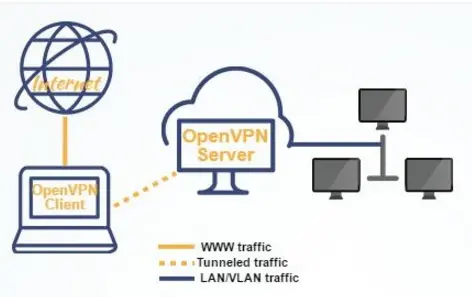
Working process:
-
The client initiates a VPN connection over the internet, creating a tunnel between itself and the server. Data transmitted through the tunnel is encrypted for protection.
-
The OpenVPN server receives encrypted traffic, decrypts it, and directs it to devices in the local network (LAN).
-
The client gains access to internal resources as if physically located in that network, including file servers, databases, or corporate applications.
2. WireGuard
WireGuard is a new protocol that is rapidly gaining popularity due to its speed and efficiency. It was developed as a lightweight alternative to OpenVPN and IPSec.
-
Encryption algorithms:
-
ChaCha20 for encryption.
-
Poly1305 for authentication.
-
Curve25519 for key exchange.
-
SipHash24 for hash table keys.
-
HKDF for key derivation.
-
BLAKE2s for hashing.
-
-
Lines of code: ~4000 (for comparison, OpenVPN — 100,000 lines), making it less prone to errors. (Optimization, ladies and gentlemen!)
-
Features:
-
Fast connection and low latency.
-
Built-in support in Linux kernel since version 5.6.
-
Usage example:
-
Gamers who need minimal latency.
-
Businesses that need high-performance VPNs for remote employees.
Working process:
*By the way, couldn't steal this picture*
-
The client sends its public key to the WireGuard server. The server adds the client to its list of peers, setting allowed IP addresses for traffic routing.
-
The client creates a tunnel via UDP protocol, using ChaCha20 for data encryption and Poly1305 for message authentication. The tunnel activates only when there is traffic.
-
The client sends data through the tunnel. Packets are encrypted using the server's public key and include tags for routing and authentication.
-
The WireGuard server receives encrypted data from the client. Tags are verified to confirm authenticity, after which the server decrypts the data using the client's key.
-
Decrypted data is directed to target devices in the local network (LAN) or to the internet if the client routes all its traffic through the VPN.
-
If the client is inactive for a long time, WireGuard automatically "forgets" the peer to reduce server load. When activity resumes, the client re-establishes the tunnel, transmitting updated keys.
WireGuard, thanks to its speed and security, is an excellent choice for most VPN services. However, there are other protocols, such as Trojan, which offer additional capabilities. Trojan combines VPN and proxy functionality, using HTTPS traffic for masking, making it an effective tool under strict traffic filtering conditions. For example, PQ.Hosting uses Trojan in its services to ensure stable and secure access even in complex network conditions.
3. IKEv2/IPSec
IKEv2 (Internet Key Exchange version 2) works in pair with IPSec to create secure connections. This protocol is often used on mobile devices due to its ability to quickly reconnect when changing networks.
-
Encryption algorithms: AES-256, HMAC-SHA2.
-
Features:
-
Supports roaming (e.g., when switching between Wi-Fi and cellular networks).
-
Easy to configure, making it popular for mobile platforms.
-
Usage example:
-
Mobile users who travel frequently.
-
In corporate environments for connecting employees to remote offices.
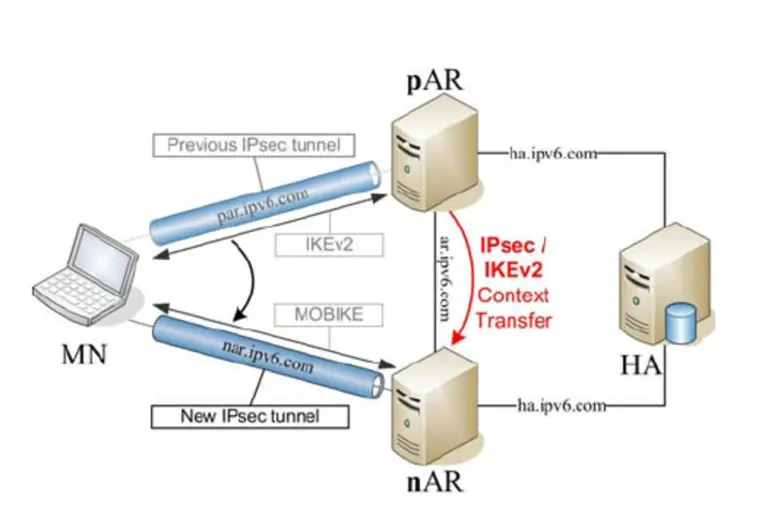
Working process:
-
MN connects to pAR through an IPSec tunnel. All data is transmitted through this tunnel using IKEv2 for encryption and connection management.
-
MN loses connection to pAR (e.g., due to leaving Wi-Fi range) and tries to connect to nAR.
-
MOBIKE automatically switches MN's connection to nAR, creating a new IPSec tunnel.
-
IKEv2/IPSec context is transferred from pAR to nAR to maintain the current VPN state. This allows avoiding re-authentication and minimizing disconnections.
-
MN starts transmitting data through nAR. HA continues routing traffic for MN as if the connection was not interrupted.
4. L2TP/IPSec
L2TP (Layer 2 Tunneling Protocol) is combined with IPSec to enhance security. This protocol is less effective than modern solutions but is still used in some networks.
-
Encryption algorithms: 3DES, AES.
-
Features:
-
Simple configuration.
-
Susceptible to blocking as it uses standard ports.
-
Usage example:
-
Networks where basic protection is required without complex configuration.
-
Services that don't require high speed.
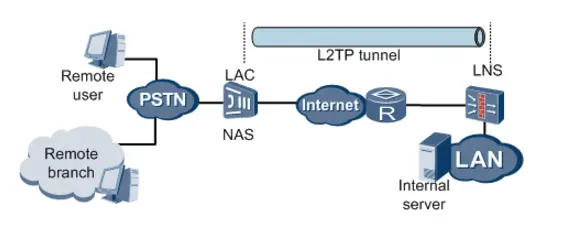
Working process:
-
The remote user initiates a connection to NAS via PSTN or another provider gateway.
-
NAS (or LAC) creates an L2TP tunnel over the internet to LNS, protecting transmitted data.
-
LNS receives data, terminates the tunnel, and directs it to the local network (LAN).
-
The remote user gains access to internal network resources as if located inside it.
5. PPTP
PPTP (Point-to-Point Tunneling Protocol) is one of the first VPN protocols. Today it is considered outdated due to weak encryption and vulnerabilities.
-
Encryption algorithms: MPPE (Microsoft Point-to-Point Encryption).
-
Features:
-
High speed due to minimal encryption.
-
Low security level.
-
Usage example:
-
Connecting to legacy corporate networks.
-
Streaming content where security is not a priority.
Working process:
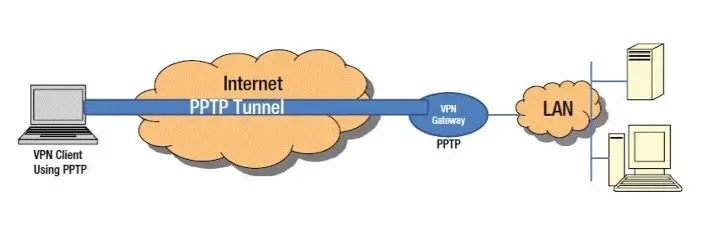
-
The client establishes a connection with the VPN gateway over the internet using PPTP.
-
After successful authentication, a tunnel is created that encrypts and transmits data between the client and the gateway.
-
The VPN gateway routes client traffic to devices and resources of the local network (LAN), providing access to them.
Comparison of VPN Protocols
Table with key characteristics:
|
Protocol |
Encryption |
Speed |
Security |
Compatibility |
Recommended Use |
|
OpenVPN |
AES-256, TLS |
Medium |
High |
All platforms |
Universal, corporate networks |
|
WireGuard |
ChaCha20, Poly1305 |
High |
High |
Linux, Windows, Mac |
Gaming, high-performance VPNs |
|
IKEv2/IPSec |
AES-256, HMAC-SHA2 |
High |
High |
Mobile devices |
Mobile networks, corporate VPNs |
|
L2TP/IPSec |
3DES, AES |
Medium |
Medium |
All platforms |
Basic protection |
|
PPTP |
MPPE |
High |
Low |
Legacy platforms |
Fast access without security |
VPN Protocol Usage Examples
VPN protocols are chosen depending on the tasks that need to be solved. Different protocols provide optimal conditions for business, personal use, or specialized needs. Let's examine examples in more detail.
For Business
-
OpenVPN
Used by many large companies due to its reliability, flexibility, and high security. This protocol allows creating secure corporate networks, which is especially important for organizations working with confidential data.
For example: A company creates a centralized network for branches, where employees securely exchange data through a single VPN network using OpenVPN on corporate devices. -
IKEv2/IPSec
An excellent choice for companies with mobile employees. The protocol supports fast switching between Wi-Fi and cellular networks, making it indispensable for traveling workers.
For example: An IT company provides its employees access to corporate email and CRM system through IKEv2, allowing them to maintain a stable connection even when changing access points. -
WireGuard
Appears in corporate networks as a solution for high-performance connections. Easy configuration and low server load make WireGuard a promising choice for business.
For example: A startup with limited resources sets up WireGuard for secure employee connections, minimizing equipment costs.
For Personal Use
-
WireGuard
The protocol offers an ideal combination of speed and security, making it an excellent choice for streaming, online gaming, and accessing content without delays.
For example, you can watch Netflix in another country through WireGuard, enjoying high speed and low latency. -
OpenVPN
Suitable for users who value versatility and customization options. Often used to bypass blocks and protect data in public Wi-Fi networks.
For example, you travel and connect to public Wi-Fi hotspots through OpenVPN for safe internet browsing. -
PPTP
Although this protocol is outdated, it is still used for quick access to content where security is not critical.
For example, you connect to PPTP to access regionally blocked websites or streaming services. (Familiar, right?) -
L2TP/IPSec
Preferred for basic tasks where a simple and affordable solution with moderate security is required.
For example, You have your own small business and use L2TP/IPSec for remote access to the warehouse management system.
Encryption Reliability
Data encryption is the foundation of VPN security. Various protocols use their own encryption algorithms, which differ in reliability level and data processing speed. Let's look at the most popular algorithms:
-
AES (Advanced Encryption Standard)
The standard for most modern protocols, including OpenVPN, IKEv2, and L2TP/IPSec. Uses 128- or 256-bit encryption. AES-256 provides a high level of protection and is suitable for banking operations or transmitting confidential data. -
ChaCha20
A fast and secure algorithm used in WireGuard. It works faster than AES on low-performance devices such as smartphones or tablets. -
MPPE (Microsoft Point-to-Point Encryption)
An outdated algorithm used in PPTP. Suitable only for tasks where security doesn't matter.
Popularity of Encryption Algorithms:
|
Encryption Algorithm |
Protocols |
Popularity |
|
AES-256 |
OpenVPN, IKEv2 |
60% |
|
ChaCha20 |
WireGuard |
30% |
|
MPPE |
PPTP |
10% |
For Developers and IT Administrators
-
WireGuard for test environments
The protocol allows quickly deploying a VPN network for testing applications or network settings. Small codebase and high performance make it a convenient tool for developers. -
OpenVPN for hosting
Used to protect remote access to servers and cloud platforms. For example, for managing VPS or web hosting.
Example: An administrator connects to a hosting server through OpenVPN to perform configuration without risk of data leakage.
For Entertainment and Media Consumption
-
PPTP for regional content
Despite its outdated architecture, PPTP remains popular for unblocking content in regions with restrictions.
Example: A user from Europe uses PPTP to watch regional sports broadcasts from the USA. -
WireGuard for gaming
Thanks to minimal latency and high speed, WireGuard has become popular among gamers, especially in games where reaction is important (e.g., shooters or MMORPGs).
Example: A gamer connects to a WireGuard server for a stable connection with game servers in another country.
Conclusion
VPN protocols are designed for various tasks, from high security to ensuring maximum speed. Understanding the features and usage examples will help choose the right protocol for your needs, whether it's business, gaming, or basic data protection. OpenVPN and WireGuard remain universal leaders, but protocols like IKEv2 and even the outdated PPTP find their place in specific scenarios.