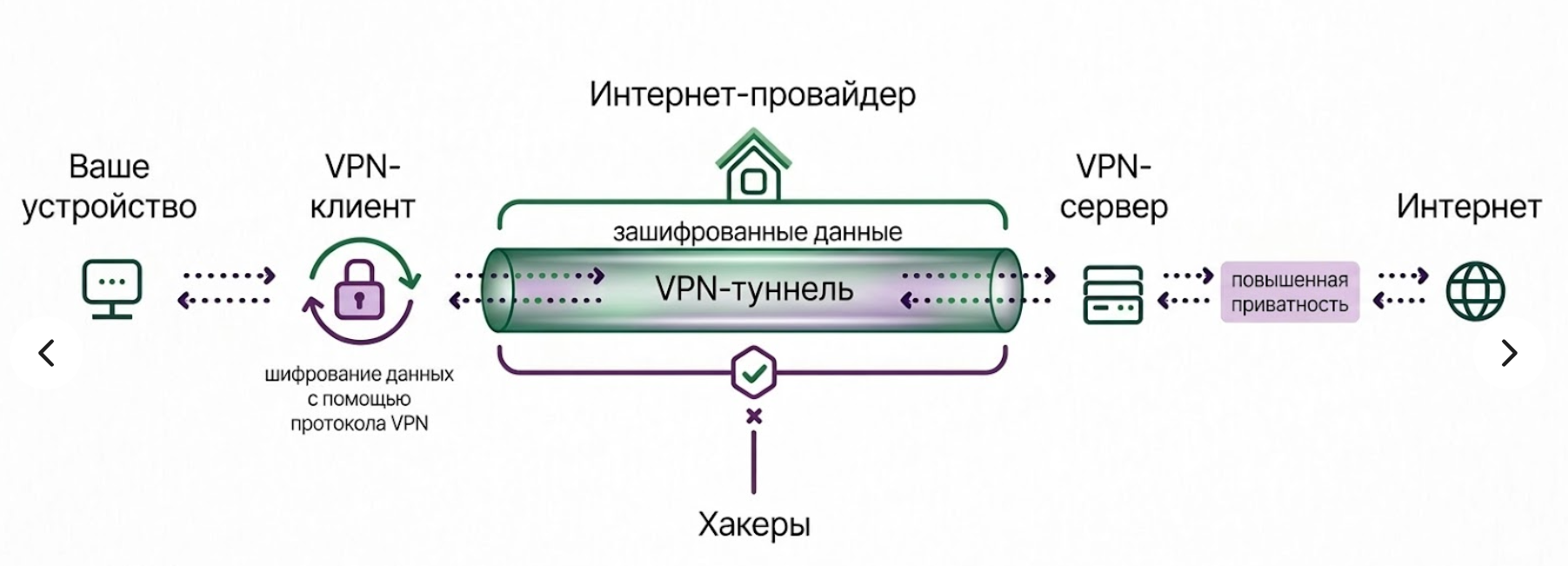
Virtual Private Network or VPN (Eng. Virtual Private Network or VPN) is a technology designed to create a secure logical connection over network infrastructure[1][2][3]. The main goal is to ensure the confidentiality, integrity, and authenticity of transmitted data. VPN operation is based on the principles of tunneling and encryption[4]. Tunneling allows data packets to be wrapped in a protective shell, hiding their content from external network nodes. Encryption converts information into code that cannot be read without a special key[5]. Despite privacy functions, the technology is criticized because the server owner can technically log traffic, leading to potential de-anonymization, and it is vulnerable to DPI filtering systems that allow regulators to block such connections. In several countries, VPN use is legally restricted, and the architecture itself does not guarantee complete anonymity[6][7].
| VPN (Virtual Private Network) | |
|---|---|
| Type | Network Technology |
| Developers | Various (Microsoft, Cisco, Open Source community) |
| Interface Languages | Multilingual |
| First Release | 1996 (PPTP protocol) |
| License | Various (GPL, proprietary) |
| Website | ietf.org (protocol standards) |
In 1993, the first attempts at software traffic encryption began. In 1996, Microsoft introduced the PPTP protocol[3][8], which became the first mass-market solution for remote access. In 1998, the IPsec stack was standardized, becoming the foundation for secure corporate backbones[9].
In 2001, the OpenVPN project appeared[10], offering flexibility and open-source code. The use of SSL/TLS protocols allowed masked secure traffic to look like regular website visits. In 2005, the IKEv2 protocol was presented, ensuring stable connections when mobile devices switched between Wi-Fi and LTE networks[11].
Since 2015, active implementation of WireGuard has begun—a protocol with minimal code volume and high performance. In 2020, the pandemic triggered a sharp rise in VPN use for remote work[12]. By 2026, the technology had become part of cloud security services (SASE), providing data protection at the level of global gateways[13].
Tunneling or encapsulation is the basic process of VPN operation[14]. When sending data, a network packet is placed inside another packet, which serves as a transport vehicle. External network nodes see only the headers of the transport packet, while the content remains hidden and protected.
Modern cryptographic standards are used to ensure security. In 2026, the most demanded algorithms are AES-GCM and ChaCha20-Poly1305[15][16]. They provide high-speed data processing even on mobile devices. Additionally, the system verifies the authenticity of each connection participant via digital certificates or keys. Integrity control ensures that data has not been altered by attackers during transmission. If a data packet is modified en route, the VPN system automatically discards it, which is critical for banking transactions and industrial equipment management.
The logical structure of a VPN includes several interacting elements that distribute tasks for protection and routing.
The Access Server (VPN Gateway) is the central node[17]. It accepts connections, verifies user rights, distributes internal addresses, and encrypts data. The client node is the user's device with installed software that creates a request to establish a secure tunnel.
The "Site-to-Site" scheme is used to connect offices. In this case, the network equipment of two objects connects automatically. The "Remote Access" scheme allows an individual to connect to their company's server from anywhere in the world via a regular browser or special application.
The legal framework in Russia clearly distinguishes between the technological use of VPNs and services for accessing blocked information[18].
VPN technology in Russia is legal[19] but restricted. It is officially recommended and used in the banking sector and large businesses to ensure communication channel security. Legal entities have the right to notify Roskomnadzor about their technical solutions to exclude them from automatic blocking systems[20]. Restrictions apply exclusively to using VPNs to bypass blocks on resources deemed illegal[21]. Since 2024, advertising and promotion of methods to bypass restrictions have been banned in Russia[22]. Technical means (TSPU) allow the regulator to automatically detect and restrict the operation of foreign commercial services that refuse to comply with Russian legislation[23][24].
On March 30, 2026, it became known that the Ministry of Digital Development is working on a package of measures to restrict the use of bypass tools. Among the proposed initiatives are a ban on topping up Apple ID via mobile phone accounts, introducing fees for international traffic exceeding 15 GB per month, and restricting access to digital services for users with enabled VPNs. The Minister noted that fines for using such tools are not currently being considered[25].
On April 5, 2026, the Ministry of Digital Development acknowledged that detecting VPN use on iOS devices is significantly limited due to Apple's privacy policy, which isolates third-party apps and prevents them from collecting data from other programs. In methodological recommendations sent to major internet companies (Sber, Yandex, VK, Wildberries, Ozon, Avito, X5, etc.), the department demanded that by April 15, they block access to services for users with enabled VPNs, otherwise companies risk losing IT accreditation, benefits, and inclusion in mandatory pre-installation lists. It is noted that detecting VPNs on Android is easier thanks to available system APIs, whereas on iOS, a comprehensive approach is required, including IP address checks and subsequent confirmation stages[26].
In most countries (USA, European Union, Japan), VPN is an absolutely legal tool[27]. Legislation views it as a means of protecting personal data and corporate intellectual property. Providers in these countries are not required to restrict user access to information. A number of states allow the use of only those services that have undergone state certification and agreed to comply with traffic filtering requirements. Using unauthorized services may result in administrative liability[28][29].
In some countries (India), VPN providers are required to store personal data and user IP addresses for a long period—this has led to the departure of many international companies from the local market, as such requirements contradict the privacy principles inherent in the technology itself.
| Protocol | OSI Level | Pros | Cons |
|---|---|---|---|
| IPsec | Network (L3) | Very high security, bank standard | Complex configuration |
| OpenVPN | Application (L7) | Passes through any firewalls | Loads device processor |
| WireGuard | Network (L3) | High performance according to independent tests | Fewer configuration options |
| IKEv2 | Network (L3) | Stability on smartphones | Requires firmware support |
In the corporate sector, VPN allows creating a unified information space for distributed teams, enabling employees to safely work with internal CRM systems and email[30]. In industry, the technology is used for remote configuration of machines and sensors in hazardous production environments[31][32]. The main risk is the use of free and unverified applications[33]. Mass data leaks from such services have been recorded, where user passwords and personal photos ended up in public access. Furthermore, incorrect configuration can lead to data leaks bypassing the tunnel, nullifying all protection benefits[34]. Using VPN does not eliminate all cyber threats. The technology does not protect against malware on the device, phishing attacks, and credential compromise, nor does it guarantee complete anonymity: the VPN provider can technically have access to connection and traffic information.
 English
 Русский